Alternative Forms of Capital
Startup funding
Knowing your funding options
ALTERNATIVE FORMS OF CAPITAL
What types of alternative funding are available to founders?
✔️A close look at startup funding in the Australian tech ecosystem
✔️Why knowing your funding options is critical to business success
✔️What type of funding is your business eligible for?
✔️Pitfalls to avoid, and why
✔️How Scalare can help you navigate the process
FORMS OF CAPITAL
At Scalare , we’re on a mission to create a greater impact by building a powerful, collaborative network that connects exceptional founders, advisors and investors in a unique and powerful partnership.
We believe that real transformation takes more than money – however, new businesses require capital to both scale and succeed!
Our long experience helping businesses successfully raise expansion capital has shown us time and again how founders approach this process will be fundamental to their level of success and the amount of capital raised.
How do you successfully navigate all the alternative types of capital available to startups?
Finding funding options for your startup can be a stressful, time-consuming, and tricky process.
In Scalare's capital raising series, we covered the journey to securing growth capital via the traditional funding sources. However, at times when investment markets are tighter for startups looking to raise capital, or this isn’t a viable option for your business, it makes sense to widen your horizons and look elsewhere for opportunities to bring funds into the business.
For startups, the range of funding options can be overwhelming. Should you tighten your belt and bootstrap, crowdfund or get a business loan? And how do you even begin to navigate all the grants on offer?
At Scalare we understand that founders are frequently stretched thin across their businesses. Startups are hard work for founders and the need to find funding can be stressful, time-consuming and take you away from your crucial day-to-day business activities.
Our team of investment experts understand the types of funding options for founders and can help demystify the choices that are available.
Becoming familiar with alternative funding options will help you navigate and negotiate across them and maximise your chances of achieving a successful funding mix.
Getting started with startup capital
In this guide we’ll take you through 19 different options for startup funding, what they are, explore the pros and cons for each, and show you where to get more help.
1. Bootstrapping
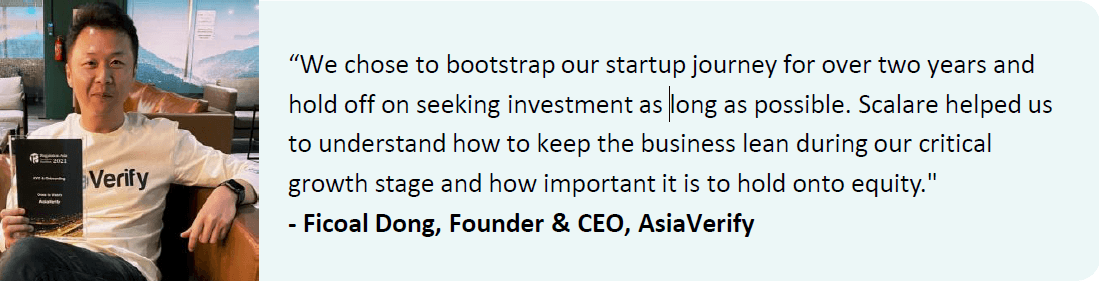
Bootstrapping means launching your startup with your own cash and sustained by your revenue. It usually involves cutting costs wherever possible, solving problems without excessive expenses, and remaining as lean as possible through critical growth stages.
✔️Pros: Bootstrapping stimulates creative thinking, resourcefulness, and aiming to achieve more with less. It will naturally build your culture to focus on maximising capital efficiency. Bootstrapping will commonly help founders hold onto equity in the early stage of their business.
❌Cons: In some cases, this approach can restrict the speed at which your business scales.
How Scalare can help: We helped investee company AsiaVerify reach certain milestones in their business before seeking capital. Once AsiaVerify had launched its product and gained international customers, Scalare, along with other shareholders, was ready to invest growth capital in the business.
2. Financing through clients
This is where your business is funded by future revenue, for example, the client pays for an annual subscription in advance (as opposed to monthly).
✔️Pros: No dilution, it focuses the Founder’s mind on growing the business, and increases the valuation of the business.
❌Cons: The business may be slower to scale without additional funding to accelerate growth.
3. Loan from friends and family
Financing through your network of friends and family is a popular choice for early-stage startups.
✔️Pros: A quick and easy method to raise funds. Friendly terms, and no or very little dilution of ownership.
❌Cons: May complicate personal relationships.
Scalare recommendation: Despite how close the relationship is, have a properly written agreement in place to set expectations and avoid any future disputes.
4. Crowdfunding
Crowdfunding is a way to finance your business by collecting money from a large number of people, frequently through platforms such as Kickstarter. Often used by startup companies or growing businesses as a way of accessing alternative funds, it is usually suitable for startups seeking an alternative to equity funding who have an existing product available.
✔️Pros: In exchange for money raised, founders can offer their supporters goods or services for free (or at a discount), or issue shares in the business. Offering goods or services suits new businesses launching a new product or a business without any revenue. Companies also use this method to gain exposure.
❌Cons: Be mindful of equity dilution and being able to fulfill your obligations.
Scalare recommendation: Having a few supporters ahead of publishing your campaign can go a long way. Their enthusiasm can help spread the message and, ideally, kick off the financial contributions.
5. Unsecured business loan
There are a range of loans available in the marketplace. As an example, Zip Business Capital offers unsecured business funding up to $500K.
✔️Pros: No security is required, there is a quick online application, fast turnaround to obtain funds, and flexible payment terms.
❌Cons: Usually requires the applicant to reach profitability. Fees apply for draw-down and interest rates. Australian businesses need to fulfil minimum criteria as part of the assessment process, with a certain level of turnover, length of trading and proof of profitability.
Scalare recommendation: Make sure to do sufficient research, and review all terms of the loan carefully before proceeding.
How Scalare can help: We have helped investee companies to successfully apply for business loans of varying sizes.
6. Unsecured business capital
There are a range of corporate card and credit cards available in the marketplace. As an example, Cape offers up to $500K unsecured capital* on a corporate card to help ease cash flow in your business. *Terms and Conditions apply.
✔️Pros: No foreign transaction fees. Affordable subscription fees. No security is required. Applications are turned round in 24 hours.
❌Cons: Australian businesses need to fulfil certain minimum criteria as part of the assessment process, with a certain level of turnover, length of trading and proof of funds.
Scalare recommendation: Review existing foreign transaction spend to understand FX fees cost savings by using Cape.
Find out more: https://www.getcape.io/business-credit-cards
GOVERNMENT FUNDING
7. Australian Government Funding: R&D Tax Incentive
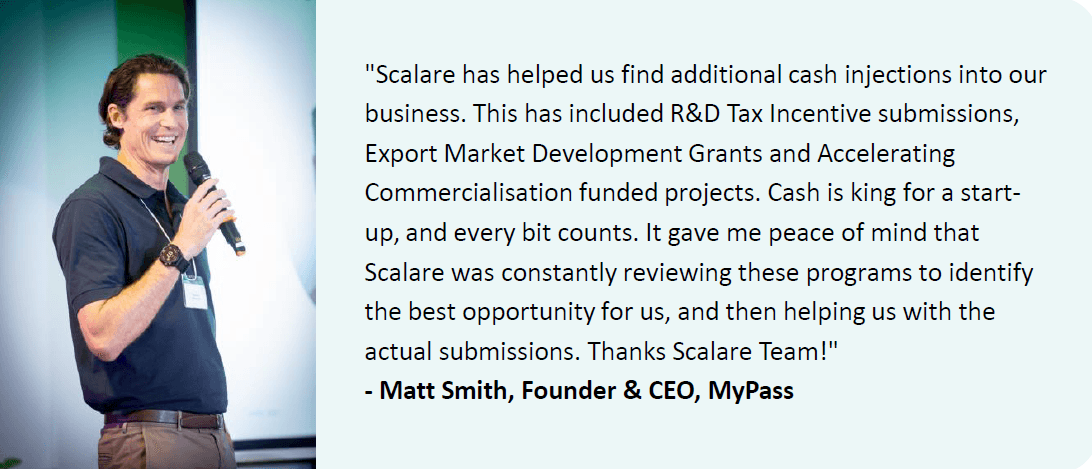
The Research and Development Tax Incentive (R&DTI) offers a tax offset for companies conducting eligible R&D activities. It encourages investment in R&D to help your company to grow and innovate which generates benefits for the Australian economy. Your business must be participating in genuine R&D activities (with expenses incurred in Australia) and be spending capital on R&D in the current financial year.
✔️Pros: The refundable tax offset is your corporate tax rate plus an 18.5% premium. If the applicant is running at a loss, they may be entitled to a 43.5% tax offset, paid as a cash rebate.
❌Cons: Time and cost is required to prepare accounts at the end of the financial year, and then file an R&D tax credit claim as part of an annual income tax return. This process typically takes 6 to 12 weeks after filing to complete.
Scalare recommendation: Engage a grant consultant, or leverage a Scalare advisor to help.
For more information: https://business.gov.au/grants-and-programs/research-and-development-tax-incentive/overview-of-rd-tax-incentive
How Scalare can help: We have helped a number of our investee companies prepare their R&D tax incentive claims, including preparing the financial statement, tracking all eligible costs, compiling the application form and building R&D strategies.
8. Australian Government Funding: Accelerating Commercialisation
Accelerating Commercialisation is a service under the AusIndustry Entrepreneurs’ Programme that provides you with advice and funding to get your novel product, process, or service to market. It is suitable for businesses, start-ups and researchers who have a novel product, process or service ready to scale up and commercialise in global markets.
Your business needs to have a combined annual turnover of less than $20 million for each of the previous 3 financial years.
✔️Pros: The successful applicant can get up to 50% of eligible expenditure to support their commercialisation project along with support from their Facilitator throughout the life of their commercialisation project.
❌Cons: A quarterly report is required along with an audit report at completion of the project, in order to claim residual balance.
Scalare recommendation: Engage a grant consultant, or leverage a Scalare advisor to help. For more information: https://business.gov.au/grants-and-programs/accelerating-commercialisation
How Scalare can help: This type of grant requires quite a heavy load of reporting. We have helped our investee companies prepare the application and submit quarterly and annual reports and supporting documents.
9. Export Market Development Grants
Austrade’s Export Market Development Grants (EMDG) program helps Australian businesses grow their exports in international markets. These grants encourage small to medium enterprises to market and promote their goods and services globally.
Applicants can apply for grants over 8 years in total (but not necessarily consecutively).
✔️Pros: Flexible approach: You can apply for any grant tier (out of the 3 tiers available) at any time depending on your business need.
❌Cons: Progress reports are required to be submitted to report milestones and actual spending vs budget.
Scalare recommendation: Proper accounting record keeping is critical, including a travel diary, web traffic analysis and other supporting documentation for your reports.
For more information: https://www.austrade.gov.au/australian/export/export-grants
How Scalare can help: We have helped our investee companies prepare the application and submit quarterly and annual reports and supporting documents.
10. Australian State Grants
There are a number of grants available across Australian States. We recommend using the Australian Government’s ‘Grants and Programs Finder’ to help. If you’re doing business in Australia, this guided search will help you find grants, funding and support programs from across government.
✔️Pros: Usually less complicated / competitive than Australian National Grants
❌Cons: Usually a smaller amount than Australian National Grants
Scalare recommendation: Can be handled in-house
For more information: https://business.gov.au/grants-and-programs?resultsNum=10
How Scalare can help: We have helped our investee companies to prepare State Grant applications.
11. Australian National Grants
There are a number of grants available across Australia. We recommend using the Australian Government’s ‘Grants and Programs Finder’ to help. If you’re doing business in Australia, this guided search will help you find grants, funding and support programs from across government.
✔️Pros: Usually larger amounts than the Australian State Grants.
❌Cons: National grants require more time to prepare for the application than the Australian State Grants and have a longer application review/approval cycle. They can also receive more applications than the state grants. Government grants often ask you to match up to 25% or 50%of the funds. This means you must raise that money before it can be matched. It’s also likely that you will have to spend money and claim it back.
Recommendation: Engage a grant consultant or leverage a Scalare advisor to help.
For more information: https://business.gov.au/grants-and-programs?resultsNum=10
How Scalare can help: We have helped our investee companies to prepare National Grant applications.
12. MVP Ventures Program
MVP Ventures is one of a suite of initiatives funded by the NSW Government under the Future Economy Fund’s Commercialisation Pathways Program, to drive commercialisation success in NSW. The applicant must be based in NSW and be able to demonstrate that 80% of development costs will occur in NSW.
Requirements:
● Be at pre-revenue stage
● Have completed a proof of concept (e.g., customer interviews)
● Have a potential business customer (B2B) or business channel to market (B2C)
● Have a scalable solution that can be deployed to multiple customers
● Hold IP rights to commercialise
● Demonstrate adequate matched funding has been secured for the project
✔️Pros: Pre-revenue technology startups can apply. An MVP grant is a matched funding grant up to 50% of approved project costs, up to $25,000. The successful applicants will receive 35% of the funding up-front and 65% after completion and validation of the MVP.
❌Cons: Need to secure matched funding.
For more information: https://www.nsw.gov.au/grants-and-funding/mvp-ventures-2025-2026-round-1
WHAT ELSE IS THERE?
We’ve outlined a few more funding sources in this next section.
With each of these options, it's important to do your homework first. We recommend you compare your providers carefully and do thorough research to understand key funding terms and fees before signing up.
13. Venture debt funding
Venture debt is a type of loan offered by banks and nonbank lenders that is designed specifically for early-stage, high-growth companies who have venture capital backing. Venture debt follows on from equity rather than replacing it, as lenders refer to venture capital support as a reference for providing the loan. This type of funding differs, depending on the provider.
✔️Pros: Helps to extend your runway and avoid dilution.
❌Cons: Comes with interest costs. In many cases, debt funding also requires that startup founders offer up their business as a security.
Scalare recommendation: It’s important to find a provider who align with the long-term goals of your startup, even at slightly higher fees.
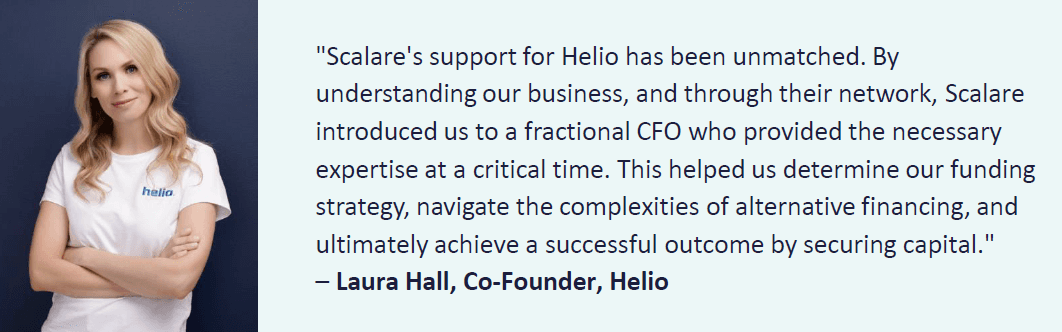
How Scalare can help: We have helped our investee companies to build the financial model to assist the application, and reviewed and negotiated the terms of the agreement before signing.
14. R&D Debt Financing
The difficulty with the R&D incentive (explored in point 6.) is that it takes a long time to disburse, leaving founders unable to leverage the capital it provides in the short term. R&D debt financing is a way to access the funds in the year in which the R&D spending occurs, rather than waiting for payment from the ATO.
It is a new type of financial instrument that allows a company to use the future R&D tax incentive payments as collateral for a debt facility. To qualify, the business needs to incur R&D eligible expenditures, prepare accounts at the end of the financial year and file an R&D claim as part of the tax return. A reputable provider can help you assess whether your current R&D spending is eligible for the R&D tax incentive.
✔️Pros: Allows a company to use its future R&D tax credit payments as collateral for a loan, providing working capital before the actual R&D tax incentive application is approved and paid by the ATO.
❌Cons: Loan interest and set up fees will be incurred.
15. Revenue-based financing
Revenue-based financing, also known as royalty-based financing, is a method of raising capital for a business from investors who receive a percentage of the enterprise's ongoing gross revenues in exchange for the money they invested.
Suitable applicants:
● Are a small to mid-size services business (not seed stage)
● Have strong recurring revenue streams - for at least 6 months
● Preferably operate a SaaS business
● Receive income from multiple clients
✔️Pros: Some providers offer small and flexible repayment plans of a fraction of your monthly revenue until repayment or extension.
Application is simple, with a quick approval process.
❌Cons: Usually, a fixed percentage of future revenue will be paid to the provider as interest for the loan. The investment amount usually limited to <50% of current annualised revenues (or ARR) and is not suitable for seed-stage or companies with low revenues.
16. Accelerator funding
Startup accelerators provide early-stage companies that already have a minimum viable product (MVP) with the education, resources and mentorship needed to speed up growth. Capital is a big part of why startups seek out accelerators as they provide pre-seed or seed funding in exchange for equity.
There are hundreds of accelerators worldwide that have been instrumental in helping launch important startups (think Airbnb, Dropbox and Reddit launched by seed accelerator Y Combinator).
✔️Pros: Accelerators provide founders with access to industry experts or mentors, advice, networking and pitching opportunities.
❌Cons: If your business accepts funding in exchange for equity, beware that dilution doesn’t become a problem down the line.
17. Commercial Program for Startups
There are some commercial programs specifically designed for startups to support them in their initial phase of building their businesses. Members can access free tools, resources, content and expert support to accelerate their startup at every stage. Startups such as Spotify, Pinterest and Dropbox have attained high levels of success via the AWS Activate program.
Some commercial programs require your business to have no other outside funding aside from crowdsourcing or family and friend investment.
✔️Pros: No interest, no dilutions, and very useful if you have resource constraints.
❌Cons: If you continue to use the free services you may be locked-in to a point where you eventually need to pay for them.
18. Microlending
A microloan is a non-traditional, smaller loan. A borrower usually uses microloans if they do not have access to local financial institutions or if they want a loan smaller than what their bank will allow.
Microloan lenders are usually non-profit organisations that use money received from donors to finance the loans. Many of these microloans are subsidised by federal, state, or local grants.
These organisations focus on a specific subset of entrepreneurs such as women, minorities, or tech and food startups.
Many of these lenders provide workshops, coaching, and additional education to new entrepreneurs. They also break down the barriers to capital that many women and minority business owners face.
✔️Pros: Typically range from $5,000 to $50,000 and are an excellent option for startups that do not have access to traditional financing or credit cards.
❌Cons: These loans tend to be at higher interest rate than traditional banks.
19. Peer-to-Peer Lending
Peer-to-peer (P2P) lending is when loans are financed by multiple investors. It cuts out middlemen such as banks and building societies and takes you directly to the investor.
✔️Pros: These loans are usually at a lower interest rate than traditional banks, with a relatively relaxed lending criteria and a quick application turnaround.
❌Cons: BEWARE: These loans are not FDIC insured. That means that both the lender and the borrower are at risk.
Which type of funding is right for your business?
Identifying the right solution for your business can be a complex process. Having explored the pros and cons of each type of funding, you will ultimately need to decide what best suits your business, and how to keep as much ownership as possible whilst being able to scale and grow. It’s best to choose funding that is aligned to your business vision, and will not pose obstacles down the line.
We understand that the complex world of startup funding can be overwhelming. If you need help, our expert team at Scalare Partners can assist you with traditional and alternative ways of raising capital.
Contact us at hello@scalarepartners.com
Proudly brought to you by: